Planning a Disneyland Paris Trip: A Practical Visitor Guide
Planning a Disneyland Paris trip becomes much easier when you stop treating tickets, hotels, transport and attractions as separate bookings. They depend on one another. The number of days you can spare determines whether you need one park or both; that decision affects the ticket you buy, where you stay and how much energy you have left for the evening shows. For a first visit, a well-planned day in one park is often more enjoyable than an ambitious attempt to see everything. With two days, you can give each park the attention it deserves.
The resort is east of central Paris, close to Marne-la-Vallée–Chessy station, so visiting from the city is possible without a car. This guide follows the order in which you should make your decisions, then shows how they come together in workable one-day and two-day plans. Opening hours, attractions, prices and entertainment can change, so use the official park calendar to check the details for your actual dates.
Shape the Visit Before You Book Anything
Disneyland Paris is a resort rather than a single theme park. It includes Disneyland Park, Disney Adventure World, Disney Village and nearby Disney hotels. The two parks have separate entrances, and tickets vary in the access they allow. Understanding that layout first prevents a common planning mistake: buying a two-park ticket before deciding whether there is time to enjoy both. The railway station sits near the entrances, but getting from your Paris hotel to the station, passing security and reaching your first attraction still takes additional time.

Decide which park matters most
For travelers picturing the familiar castle, classic Disney storytelling and a broad mixture of attractions, Disneyland Park is usually the natural first choice. Main Street, U.S.A. leads toward Sleeping Beauty Castle, and the themed lands branch out from the central hub. Big Thunder Mountain, Pirates of the Caribbean, family rides, character experiences and parades can each compete for your attention. Rather than trying to fit all of them into one visit, decide whether your ideal day revolves around rides, atmosphere, photographs, characters or shows. That answer is much more useful than somebody else’s universal must-do list.

Disney Adventure World offers a different emphasis, including immersive Disney, Pixar and MARVEL settings. Following the 2026 transformation of the former Walt Disney Studios Park, its attractions and areas include World of Frozen, Frozen Ever After, Adventure Way and MARVEL Avengers Campus. If Frozen is the central reason for your trip, or your group particularly wants these newer worlds, the second park may deserve a full day rather than a hurried visit after Disneyland Park. Check its official park information and the current attraction calendar before deciding.

For a first-time family with only one day, choosing one park reduces the time lost moving between entrances and reorienting yourselves. A two-park day can be possible with the right admission, but it works best for return visitors who have a short, specific wish list in each park. If this is your only opportunity to visit for several years, consider whether spreading the experience over two days is worth more than squeezing in a second gate for a few hours. See the resort’s official location and directions and use the map references for Disneyland Park and Disney Adventure World to understand where both entrances sit.
Decide whether you need one day or two
One day makes sense if Disneyland is part of a larger Paris holiday, especially when you want the castle park and are comfortable missing some attractions. Start with a shortlist of three to five priorities, including any show or character experience that matters more to you than another ride. A realistic one-day plan allows for a proper meal, unavoidable queues, wandering and the return to Paris; it is not a promise to complete the entire park. If you’re traveling with young children, build the day around their stamina rather than treating every open hour as usable ride time.
Two days is the more relaxed option for anyone who genuinely wants both parks. You can spend one day discovering Disneyland Park without constantly checking the time, then give Disney Adventure World its own day. That makes it easier to accommodate a sit-down meal, a change in ride availability or an evening show. Extra days can be worthwhile for travelers who revisit favorite attractions or prefer a slow pace, but they are not essential to enjoy the resort. Let your interests and overall Paris itinerary determine the duration, not the assumption that more days are always better.
Choose dates with the whole experience in mind
Once you know how long you want to stay, compare possible dates using the official opening-hours and attractions calendar. Look at the operating hours of both parks, scheduled entertainment and known attraction closures, rather than choosing solely by the month or a generic crowd forecast. School holidays in France and neighboring countries, seasonal events and weekends can all influence the experience, but no simple rule guarantees a quiet day. If your trip depends on a particular show or attraction, check its availability before making bookings you cannot change.
The time of year changes what a park day feels like. Winter may bring cold or rain and earlier darkness, which makes warm layers and indoor breaks important. Summer offers longer daylight, but heat and sustained standing can be tiring. If you are arriving in Paris after an overnight flight, avoid making the park your first demanding activity unless you have deliberately built in time to rest. The best date is the one that suits your energy, travel connections and must-see experiences, not just the lowest price on a calendar.
Book Tickets and Set a Realistic Budget
Choose your admission only after fixing the visit length and the parks you intend to enter. The official Disneyland Paris ticket store shows the ticket products available for your chosen dates. For a one-day visit, pay particular attention to whether the ticket covers one park or two. For multi-day visits, check the current conditions of the offered product rather than assuming it follows the same rules as a one-day ticket. A ticket that looks cheaper at first glance may not suit your park plan, while paying for two-park access can be unnecessary if you will spend your entire day at Disneyland Park.
Dated admission is tied to a specified visit date and ordinarily does not need a separate park-date registration. An undated ticket has different validity rules and requires you to register a visit date in advance, subject to capacity. The official registration guide explains the process: sign into a Disney account, associate the ticket, select an eligible date and keep the confirmation available for admission. Read the product-specific cancellation, modification and exclusion terms before paying. Never assume that purchasing an undated ticket reserves a place on whichever day you eventually choose.
Budget for the whole trip rather than the admission price alone. Compare the final cost of tickets, accommodation, transport, meals and optional extras for the same dates and group size. A family planning one quick-service lunch will have a different total than two adults booking a themed restaurant, and a longer hotel stay may change the value of a package. If you consider a Disney Hotel + Tickets package, compare its full inclusions and conditions against booking the components separately. There is no reliable universal price estimate: availability, promotions and travel dates change the offers you will actually see.
You do not need to purchase every upgrade in advance. Disney Premier Access is optional and separate from admission; its purpose is to use a dedicated queue for eligible attractions, not to guarantee an immediate ride. When estimating your costs, keep a sensible allowance for food, drinks, transport and anything you choose to buy, then treat Premier Access or souvenirs as optional decisions rather than compulsory parts of the day. This approach gives you a budget you can actually control.
Choose Accommodation That Fits Your Park Plan
Your hotel choice should follow the kind of visit you’re planning. If Disneyland Paris is a single day of a longer city break, staying in Paris often makes sense. You can keep the same room for your museums, neighborhoods and restaurants, then travel out to the parks by RER A. The tradeoff is an early start and a return journey after a tiring day. A hotel close to a useful RER A connection or an easy transfer may be more practical for that particular day than an attractive room on the opposite side of the city.
If the resort is the main purpose of the trip, compare Disney hotels with accommodation around Chessy and Val d’Europe. Staying near the parks can make a midday rest or an easier evening return more realistic, particularly with children or on a two-day visit. Some Disney hotel bookings include benefits such as Extra Magic Time, but eligibility, park access and operating hours must be checked for your specific booking and date. Do not assume every property described as a Disney hotel is a short walk from the entrance; look at the exact hotel location and shuttle arrangements.

Hotels near Val d’Europe station offer another possibility for travelers balancing room price, space and transport. Before choosing a hotel, check the journey from its actual door to the park, the first and last useful trains or shuttles, and how you will get back after a nighttime performance. Compare the final rate including breakfast and local taxes, as well as cancellation terms, bed configuration, luggage storage and accessibility. The lowest advertised room price is not necessarily the least expensive or easiest choice once transport and effort are included.
Get From Paris to Disneyland Without Guesswork
For most visitors coming from central Paris, the RER A is the simplest public-transport route. Plan your journey to a station served by the line, then choose a train whose displayed destination is Marne-la-Vallée–Chessy. The RER A has branches, so you need to confirm the destination rather than boarding any train with the same line letter. Disneyland Paris describes the train ride from central Paris as roughly 35–40 minutes, depending on the starting station. That is the train journey, not the time from your hotel door to your first attraction.
Before the visit, use a current transit planner to work out the transfer from your hotel, the fare and ticket product required, and a reasonable departure time. Save the directions for the return as well. When you arrive at Marne-la-Vallée–Chessy station, follow the signs toward the Disney Parks and allow additional time for security and entry. The resort places the station only a short walk from the park entrances; that convenience does not remove waiting, walking or hotel transfers from your day.

For travelers who prefer not to navigate a train connection, Disneyland Paris also describes coach options from central Paris. Compare pick-up and return locations, the operator’s current schedule, accessibility arrangements and whether park admission is included in the specific offer. A coach with a fixed departure might feel straightforward in the morning but limit your flexibility if an evening performance ends later. Car travel is another option, although parking charges, traffic and the journey back should be part of the comparison. The official transport guide is a useful starting point for checking which services operate on your chosen day.
If you’re coming directly from an airport, do not assume the central-Paris RER plan is also the best airport route. Compare official airport transfers and rail connections based on where you arrive, luggage, check-in time and whether you’ll go to a hotel before the parks. Trying to manage an arrival flight, heavy bags and a full park day without a backup plan can undermine the visit before it begins. For most first-timers, a calmer arrival day followed by an early park start is easier to manage.
Organize Your Time Inside the Parks
The best way to plan attractions is to choose priorities before you arrive, then stay flexible about their order. Use the official Disneyland Paris app and park calendar to check which experiences are operating, what the posted waits look like and where the next show fits. Identify a handful of experiences you would be disappointed to miss, including height or accessibility requirements if relevant. Group nearby activities when practical rather than repeatedly crossing the park for small differences in wait time. Leave gaps: walking, queues, food and photographs take longer than they appear to on a simple itinerary.
A good opening-hour strategy is to head toward one important attraction or area, enjoy nearby experiences, and reconsider your plan once you see the actual conditions. If a ride is temporarily unavailable, shift to an alternative instead of waiting beside it indefinitely. Guests eligible for Extra Magic Time may be able to enter certain areas before the standard opening, but the parks and hours covered vary. Check your booking and the official park schedule, rather than assuming that an earlier published schedule applies to your date.
Decide whether Premier Access solves a real problem
The optional Disney Premier Access products serve different purposes. Premier Access One is for a specific eligible attraction with an allocated time slot; Premier Access Ultimate covers eligible attractions under its own rules and is not an unlimited all-rides pass. Prices and access conditions vary. Rather than treating an upgrade as automatically worthwhile, check the attractions your group actually wants and compare its current price with the time it could reasonably save you. A visitor interested primarily in shows and family experiences may get much less value from it than someone prioritizing several popular rides.
Plan meals as part of the day, not an afterthought
Meal timing affects the pace of everything around it. If a character or themed table-service meal is an important part of the visit, look at participating restaurants and book before arranging the rest of the day around a hoped-for table. Disneyland Paris currently advises that many restaurants can be reserved up to two months in advance, with different booking access for eligible Disney hotel guests. Availability is not guaranteed; check the official dining reservation page and keep a confirmation. A reservation also creates an anchor point in the day, so avoid planning an attraction on the other side of the park immediately beforehand.

If your priority is attractions, a flexible quick-service meal may fit better than a lengthy seated lunch. Decide roughly when everyone is likely to need a break, then use the app to find a convenient option near your current area. Families should account for snacks, water, restrooms and time away from noise. A comfortable break may save more energy than squeezing in one additional ride. Bring a refillable bottle and check current visitor rules for food and belongings rather than relying on advice written for an older season.
Protect time for parades and evening entertainment
Shows and character encounters should be considered while building the plan, not after every available hour has been filled with attractions. If a particular parade or nighttime performance matters to you, confirm its date and published time, then decide which activities you are prepared to miss to see it comfortably. Entertainment may vary by park and season, and operational or weather changes are possible. Set expectations before the day: if the children are tired or the final train connection is awkward, staying until the last performance may not be the best ending.
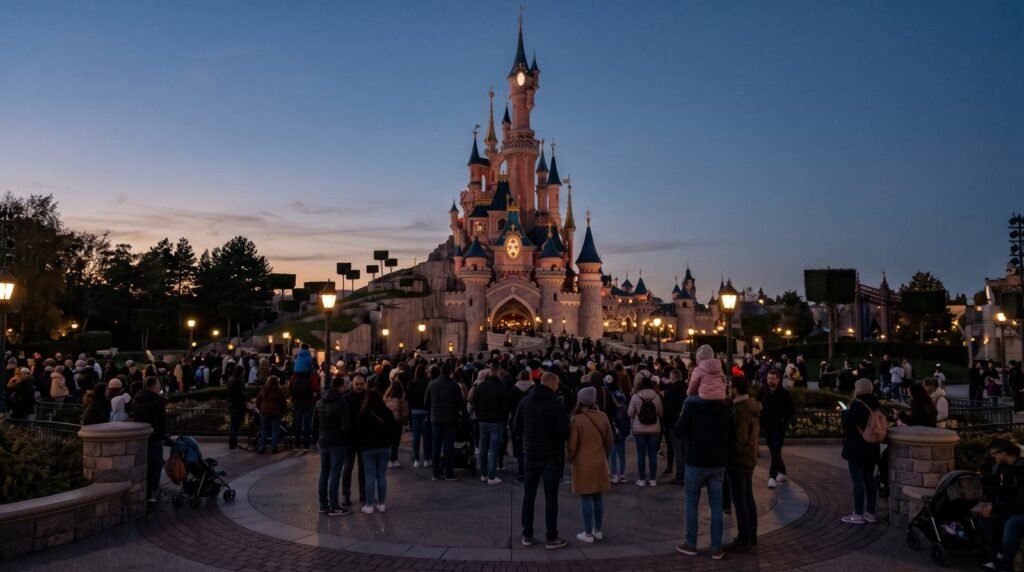
For visitors staying in Paris, check the entire return journey, including the walk back to the station, the service you intend to take and any transfer needed after leaving the RER A. It is much more relaxing to know your preferred return option before the show than to search for it in a crowd afterward. Travelers staying near the resort have greater flexibility, but they should still confirm shuttle hours or walking routes rather than assuming every hotel runs late-night transport.
Put the Decisions Together: One-Day and Two-Day Plans
The examples below are planning frameworks, not promises about ride waits or opening times. Use the operating calendar and app for the actual date, then adjust the sequence to match your interests. The goal is to keep travel, meals and entertainment in a logical order so that your day feels connected rather than a scramble between isolated attractions.
A one-day Disneyland Park visit from Paris
Before leaving Paris: Start early enough to reach the park near its official opening, allowing time for your hotel-to-station transfer, the RER A journey, security and entry. Have your admission ready in the official app or another accepted format. If a nighttime show is on your wish list, confirm the return train you intend to use before you set off.
The first part of the day: Make your way along Main Street and enjoy the castle view without letting the first photographs consume the entire morning. Choose one priority attraction or nearby themed area, then stay in that general part of the park for your next experience. A family focused on classic rides may make different choices from a group interested in thrill rides; the important point is to avoid crossing the park repeatedly for every individual attraction.
Midday and early afternoon: Stop for lunch before everyone is exhausted. Afterward, choose an experience that suits your energy level: a show, an indoor attraction, a slower ride or time exploring the themed surroundings. Check the app for the latest conditions, but use it to guide rather than dominate the day. If a planned ride is closed, replace it with something nearby instead of rebuilding the entire schedule around that single attraction.
Late afternoon and evening: Return to anything still important on your shortlist, allowing time for a parade or character experience if available. If you plan to stay for nighttime entertainment, eat or rest beforehand and choose a viewing area with a realistic exit plan. Otherwise, leave before fatigue and crowds make the return unpleasant. A successful day is one in which you enjoy the experiences you came for, not one in which you tick off the greatest number of attractions.
Two days for both Disney parks
Day one — Disneyland Park: Give the classic park the full day. Begin with the castle and a priority area, work through nearby attractions without excessive backtracking, and allow unhurried time for the themed lands. Fit a booked meal or show around its actual schedule. If you stay for evening entertainment, a nearby hotel or a planned train return can make the finish less stressful.
Day two — Disney Adventure World: Start with the immersive world or attraction that made you want the second park in the first place, such as World of Frozen or an experience in MARVEL Avengers Campus. Then explore the neighboring settings, choose another major attraction, and make room for food and entertainment rather than treating the day as a race. Check current operating details before choosing the exact order. Some guests will want to devote their second evening to this park’s entertainment; others may prefer to leave earlier, especially before onward travel.
With two days, you can change plans if rain, tiredness or attraction closures get in the way. You also avoid the pressure of deciding constantly whether to abandon one park to rush to the other. If your booking allows access to both parks on both days, you may still revisit a favorite, but build the initial itinerary as though each day has a clear home base. That makes last-minute changes a choice rather than a necessity.
Practical Planning Before Departure
A week or two before the trip, revisit the park calendar, check attraction and show notices, confirm your accommodation and table reservations, and review how you will travel there and back. Download the official app, link eligible tickets or bookings to your account and save copies of important confirmations. Keep a phone-charging option with you, choose comfortable shoes for extended walking, and pack layers that suit the forecast. A small, practical bag is often easier to manage than carrying everything you might possibly need.
Accessibility needs deserve attention before arrival. If a member of your group needs specific access arrangements, mobility support, sensory accommodations or information about attraction suitability, consult the resort’s official accessibility guidance and check any applicable documentation requirements in advance. For young children, review height limits for the attractions you have promised and allow for naps or breaks. No guide can eliminate every queue or change in schedule, but these checks remove avoidable surprises.
Finally, make sure the bookings agree with one another: your park dates match your admission, the ticket covers the park or parks you want, your hotel location fits the early morning and evening journey, and your most important dining or entertainment plans are realistic for that day. Once those essentials align, you can leave the less important choices open. A little flexibility is part of what makes a theme-park day enjoyable.
Final Thoughts on Planning a Disneyland Paris Trip
Planning a Disneyland Paris trip is less about fitting every famous ride into a schedule and more about choosing an experience that suits the people traveling with you. Decide first whether the castle park, Disney Adventure World or both are your priority. From there, choose a realistic number of days, tickets that match your plans, and accommodation that makes the journey manageable. When those decisions are settled, the attractions and meals become much easier to arrange.
A one-day visit from Paris can be memorable when you commit to one park and protect time for a few favorite experiences. Two days give you room to discover both parks at a gentler pace, enjoy the atmosphere and handle unexpected changes. Check the official information for the details that change, but do not plan every minute. The most satisfying part of the day may be the ride you anticipated—or the unhurried moment you left space to enjoy.
FAQs About Disneyland Paris Trip Planning
Can I visit Disneyland Paris on a day trip from Paris?
Yes. The RER A connects central Paris with Marne-la-Vallée–Chessy near the park entrances. Allow time beyond the rail journey for your hotel transfer, station walk, entry and return travel. A single-park itinerary is usually easier to manage in one day.
Is one day enough for Disneyland Paris?
It can be enough for the highlights of one park if you choose priorities and accept that you will miss some experiences. Two days are more comfortable if you want to enjoy both Disneyland Park and Disney Adventure World.
Do I need to register my Disneyland Paris ticket in advance?
A dated ticket normally covers the specified date without separate registration. Undated tickets generally require an advance date registration subject to availability. Always check the conditions of your particular ticket and any hotel package.
Is Disney Premier Access necessary?
No. It is an optional paid product for eligible attractions and does not replace park admission. Whether it offers good value depends on your chosen attractions, the current price and actual conditions on the day.
Should I stay in Paris or near the parks?
Stay in Paris if Disneyland is one day of a broader city visit and you are comfortable with the train journey. Compare Disney hotels and nearby accommodation if you want a two-day resort-focused trip, easier rest breaks or less travel at the end of the evening.